
Momentum trading is a powerful trading strategy that focuses on capturing strong market movements. Instead of waiting for long-term trends to unfold, momentum traders aim to profit from fast-moving price action, buying rising assets with the expectation that they will continue to climb, or selling falling assets with the belief they will drop further.
This fast-paced approach is particularly well-suited to prop trading, where traders must operate within strict rules around drawdowns, profit targets, and time limits. A carefully designed prop trading strategy built on momentum trading principles can help traders stay within firm guidelines while still unlocking significant gains. For those working with a funded trading account, momentum trading allows for efficient use of leverage and tight stop-losses, ensuring that risk stays controlled while opportunities are maximized.
Momentum Trading Strategy Explained
At its core, momentum trading follows the principle of “buy high and sell higher” or “sell low and buy back lower.” Instead of trying to catch exact tops or bottoms, traders ride the existing wave of price action.
This trading strategy can be applied to any market and timeframe, from forex prop trading on one-minute charts to stock prop trading on daily charts. What matters most is not the asset class but the strength and persistence of momentum.
Momentum traders thrive on clarity and speed. They look for conditions where price is moving decisively, and they avoid markets that are choppy or directionless. Here, trading psychology plays an important role – discipline is essential to cut losers quickly and not chase every single price movement. By sticking to high-probability setups, traders can avoid overtrading and maintain consistency.
Why Momentum Trading Suits Prop Trading
Prop firms provide traders with access to capital but require adherence to strict rules. A funded trading account typically comes with:
- Daily and overall drawdown limits
- Profit targets to be achieved within a certain period
- Restrictions on holding trades overnight or over weekends
A prop trading strategy that relies on long-term investing or holding trades for weeks would often clash with these requirements. Momentum trading, however, aligns perfectly with the prop firm model.
Because it targets short-term opportunities, momentum trading allows traders to capture gains without violating time constraints. The style also naturally supports tight stop-losses, which strengthens risk management and helps avoid breaching drawdown limits. Additionally, the ability to generate multiple trade opportunities within a session makes it easier to reach profit targets, provided traders maintain consistency in trading and avoid impulsive decisions.
In short, momentum trading provides the speed, flexibility, and control that prop trading environments demand.
Best Indicators for Momentum Trading
While some traders rely on pure price action, many incorporate indicators to refine their setups and improve trade accuracy. Several tools stand out when building a momentum-focused trading strategy:
- Relative Strength Index (RSI): Often used to identify overbought or oversold conditions, but RSI divergences can also warn of weakening momentum.
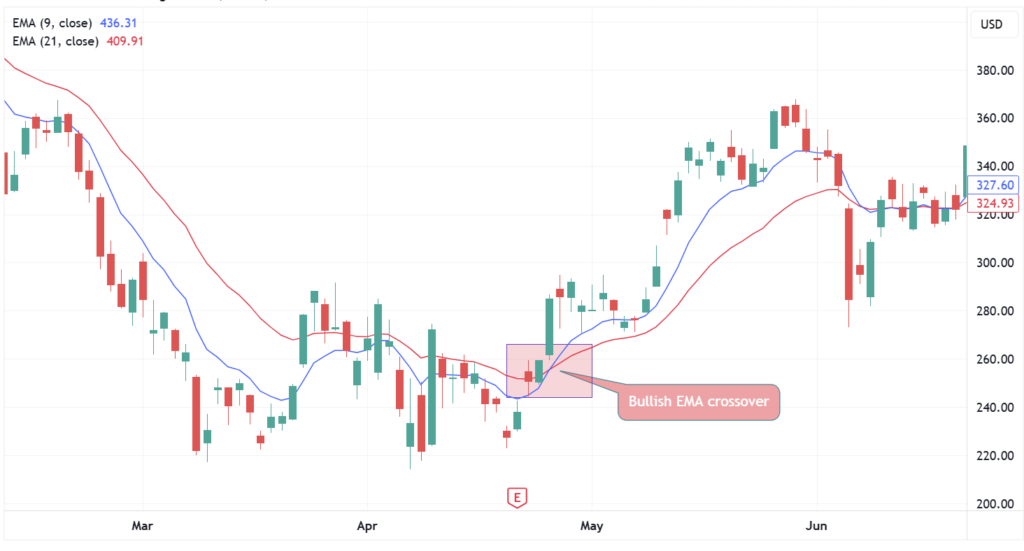
- Exponential Moving Averages (EMAs): Faster than simple moving averages, EMAs help traders spot trend continuation and crossover signals. A 9-EMA crossing above a 50-EMA, for example, often signals bullish momentum.
- MACD (Moving Average Convergence Divergence): The MACD line crossing above the signal line suggests positive momentum, while a cross below indicates negative pressure.
- Average True Range (ATR): Measures volatility and helps traders assess whether a breakout has strength behind it.
- Volume-based tools: Indicators like On-Balance Volume (OBV) and Money Flow Index (MFI) confirm whether momentum is backed by buying or selling pressure.
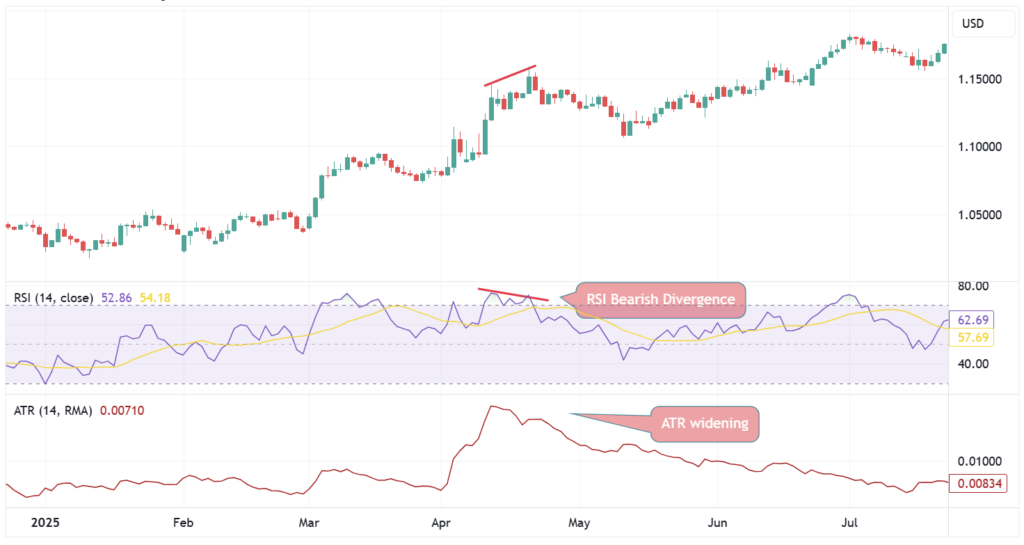
By combining these tools, traders in stock prop trading and forex markets can filter out false signals and enter only when momentum has real strength.
Finding Momentum Trade Setups
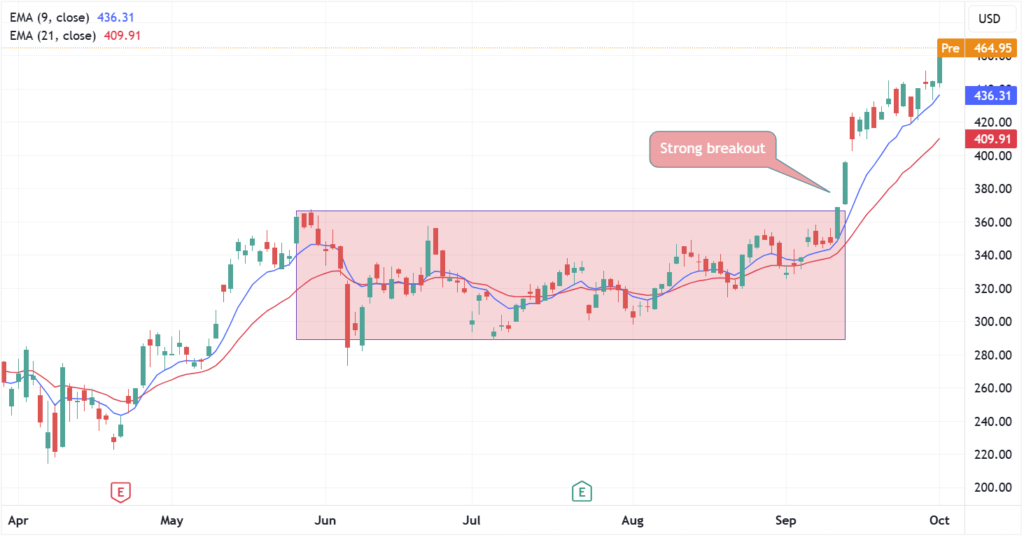
One of the most popular setups in momentum trading is the breakout strategy. This occurs when price consolidates before decisively breaking through a key support or resistance level. If the breakout is supported by volume and volatility, it signals strong continuation potential.
Another widely used approach is EMA crossovers. For example, when a short-term EMA crosses above a longer-term EMA, it suggests rising bullish momentum. However, since moving averages lag, traders often combine them with volatility measures like the ATR or momentum oscillators like the RSI.
These setups are especially useful in prop trading, where speed and clarity of execution are critical. For instance, in forex prop trading, a breakout during the London session can provide multiple short-term trade opportunities. Similarly, in futures or equities, high-volatility periods, such as after earnings releases or economic news, offer fertile ground for momentum setups.
By mastering trade selection and filtering signals effectively, traders can make the most of opportunities within a funded trading account.
Risk Management in a Funded Trading Account
No prop trading strategy can succeed without strong risk management. Momentum trading is advantageous here because it allows traders to use tight stop-loss orders.
For example, when trading a breakout, stops can be placed just below the resistance level (in a bullish breakout) or just above the support level (in a bearish breakout). If the price quickly reverses, the trade is exited with minimal loss. This precision is crucial in a funded trading account, where drawdown breaches can end a trader’s evaluation or live status.
Profit-taking requires equal discipline. Some traders target the next major support or resistance level, while others exit when momentum indicators show weakening strength. Incorporating elements of consistency in trading, such as using fixed risk-to-reward ratios, ensures that wins and losses are balanced in the long run.
In essence, momentum trading provides the tools needed to keep losses small while giving winners room to run, an ideal combination for the prop firm environment.
Example of a Momentum Prop Trading Strategy
Consider a scenario in the silver market. The metal has been trending higher, with EMAs sloping upward and price consolidating under a resistance at $39.52.
A decisive breakout above this level signals renewed momentum. A trader applying a prop trading strategy would enter long at the breakout, place a tight stop just below $39.25, and target the next resistance level higher.
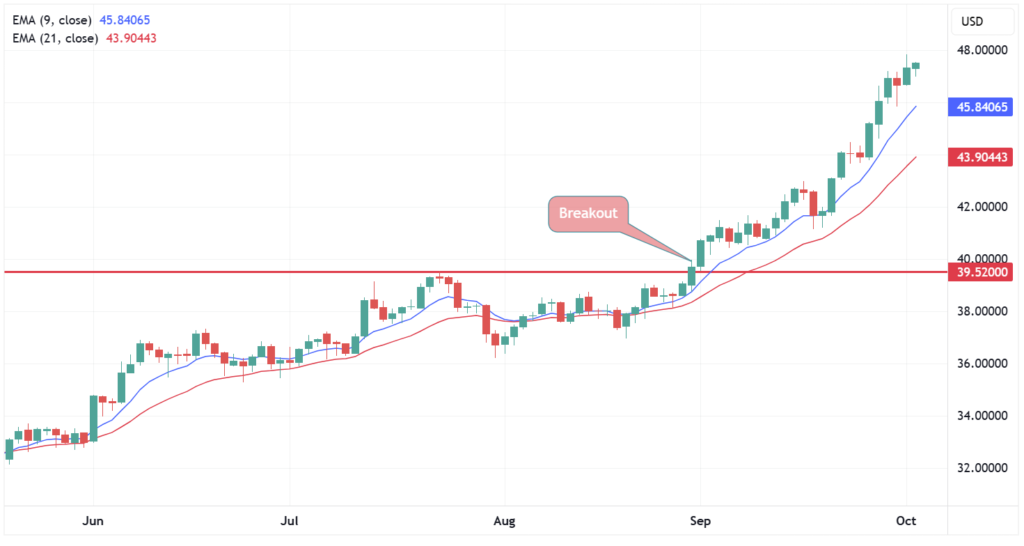
In this example, the prop trading trader benefits from:
- A clear entry trigger (breakout)
- A well-defined stop-loss aligned with risk management rules
- A momentum-driven move that fits within prop firm profit target requirements
Such setups can be replicated in both forex and equities, making momentum a versatile strategy for traders across markets.
Ready to test this strategy?
Momentum trading is one of the most practical styles for traders working within a funded trading account. By focusing on fast-moving market conditions, it provides opportunities that align well with prop firm rules around drawdowns, time constraints, and profit targets.
When applied as a disciplined prop trading strategy, momentum trading combines tight risk management with the potential for significant upside. The key is to maintain consistency in trading, avoid overtrading, and use technical tools to filter out false signals.
For traders serious about success in prop trading, mastering momentum trading could be the difference between passing an evaluation and building a sustainable long-term career.
Range trading is a trading strategy that involves profiting off markets that are moving sideways. We often hear the phrase “the trend is your friend”, and it is true that trends can involve rapid price movements from which traders can capitalize from. However, markets that move sideways can also generate plenty of trading opportunities and may suit certain types of traders better.
Range trading essentially consists of buying an asset near the bottom of the range (key support), in anticipation that it will bounce off once again and move towards the upper range. On the other hand, we would sell the asset once it is close to the top of the range, anticipating that it will be rejected at the key resistance level and head towards the lower part of the range.
Why range trading works for prop traders
Prop traders need to achieve their profit targets, but at the same time adhere to drawdown limits and risk management rules, as well as facing time limits (evaluation period). Range trading can be a suitable strategy as it is about catching smaller, high probability moves within a predefined range rather than looking for an explosive move or the next big trend.
A major advantage of range trading strategies is that it typically allows for tight stop loss orders. If price has broken out below support or above resistance, the range is broken, and there is no point in continuing the trade. Thus, traders will place the stop loss order just below the key support or just above the key resistance level.
Another reason range trading can work well for prop traders is that markets consolidate actually quite often. Even during strong trends, there are usually frequent periods of consolidation that range traders can exploit. There are also specific assets that are more suitable for range trading and have lower volatility. In the world of FX, EUR/CHF is a popular currency pair for range traders as it is (aside from the occasional spike) often moving sideways.
How to identify a trading range
A trading range is an area on the chart where price has been moving between a resistance and a support level without forming new higher highs or lower lows. It is easy to identify on the chart and looks like this:
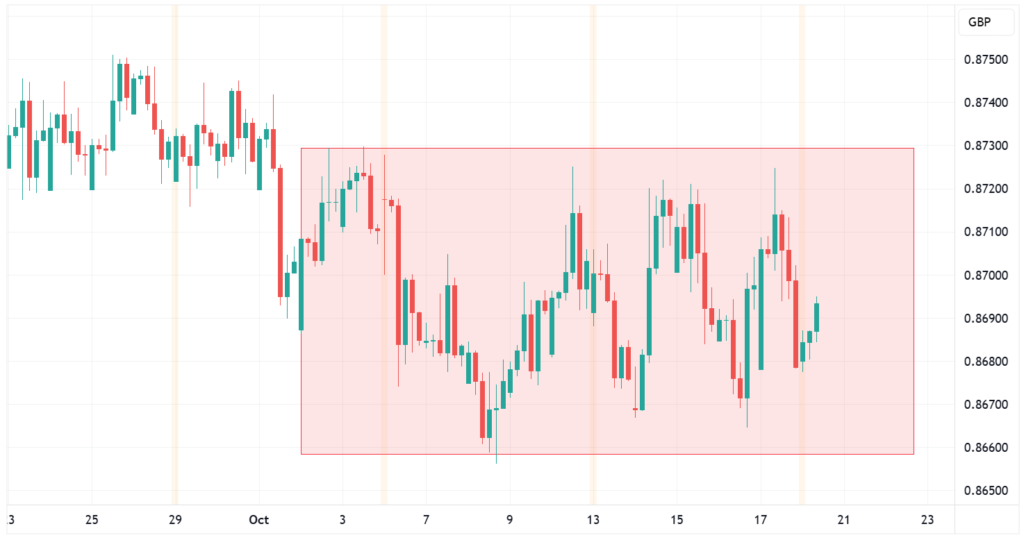
Once you have identified a range, draw the support line connecting the lows and draw the resistance line connecting the highs. Some traders also mark 50 % of the range, which typically adds as an additional support or resistance level.
Best indicators for range setups
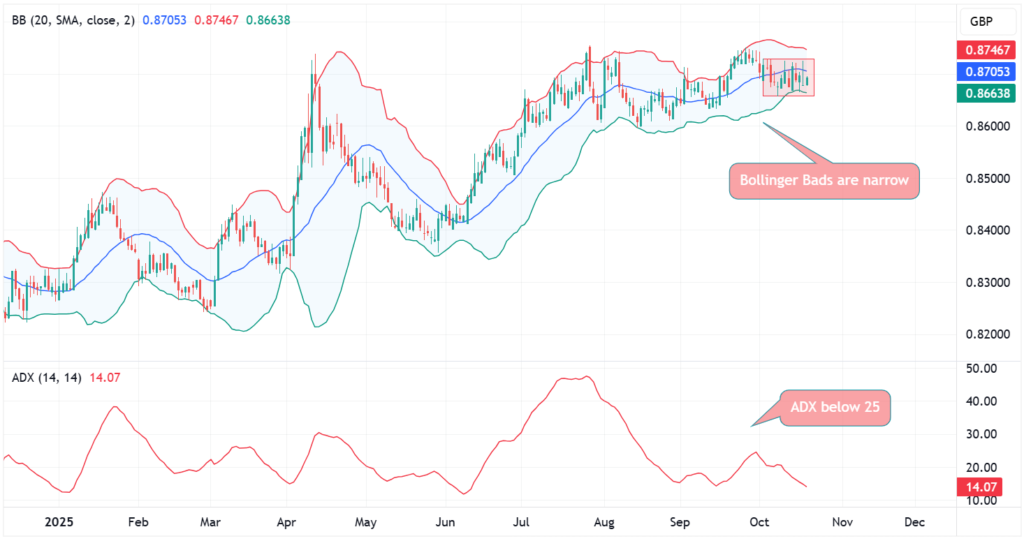
While the above described steps are often enough to establish that there is a range, traders also make use of technical indicators to confirm it. Popular indicators include:
- The Average Directional Index (ADX) – a reading below 25 indicates that the market is indeed ranging.
- Bollinger Bands – narrow bands and price moving between them is indicating a range.
- Moving Averages – during periods of consolidation, we would expect the MA to be fairly flat.
- Relative Strength Index (RSI) – the RSI should move between the 40 and 60 level during periods of consolidation.
Entry and exit techniques
When trading the range, we expect price to continue to move within the range. This means, we are looking to buy the asset at the support level (bottom of the range) and sell it at the resistance level (top of the range).
While the idea behind it is simple, the entry can be a subjective matter. Let’s see the different methods traders can use:
- Setting a limit order in advance. For example, EUR/USD is trading within a range of 1.15 and 1.17. Allowing for some slippage, we could place a sell order at 1.1690 with a stop just above 1.17 and a buy order at 1.1510 with a stop order just below 1.15. This also eliminates the need for actively monitoring the markets, although a risk is that traders set the limit order too high – meaning the order might never be triggered, missing it by a small margin.
- Watching price action as it approaches the bottom of the range or top of the range and waiting for a confirmation in the form of a rejection, possibly confirmed by a bearish candlestick pattern and/or technical indicators. This is the conservative approach but also means there could be missed opportunities or worse reward/risk ratios.
The take profit order would be placed at the opposite end of the range. For example, if we enter a short position near the top of the range, we would place the take profit order just ahead of the bottom of the range. On the other hand, if we entered a long position near the bottom of the range, we would place our take profit order just ahead of the resistance level (top of the range).
Example range trade
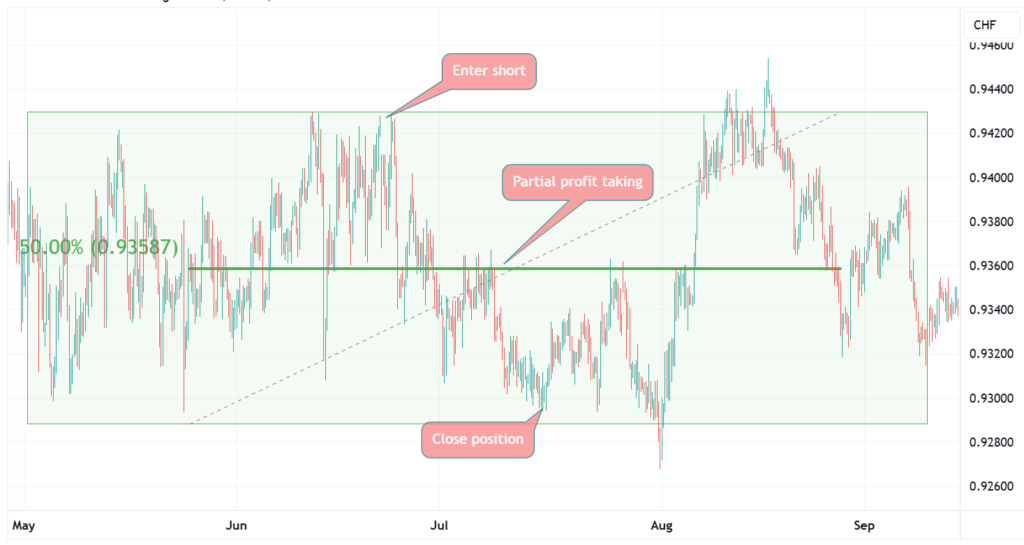
EUR/CHF has been trading within a well-defined range. In the example below, we spotted an opportunity where the currency pair is once again at the top of the range and we would enter a short position at 0.9420 with a stop loss at 0.9450. A more conservative approach would be to take partial profits at 50 % of the range, while a more aggressive approach would be to wait for another sell-off towards the bottom of the range.
Ready to test this strategy?
Range trading can work well for prop traders as it offers frequent trading opportunities and there are asset classes or instruments that are particularly suitable for this type of strategies. Range trading strategies often allow for a tight stop loss order, which is suitable for prop traders who need to adhere to drawdown rules.
That being said, range trading strategies have their limits. For example, breakouts can occur at any time and lead to losses, particularly during news events. Compared to trend trading, the profit potential can be limited as traders are not benefiting from the rapid price movements we can see during trends.
Reversal trading is a prop trading strategy based on anticipating reversal points—moments when the market trend is about to shift direction. While the popular saying “the trend is your friend” holds merit, reversal trading can be equally profitable, particularly in the forex prop trading and commodities markets.
For traders working with a funded trading account, reversals offer unique opportunities. The idea is to identify when the prevailing trend is losing strength and profit from the price movement that eventually leads to the formation of a new trend.
It is important to distinguish between a retracement (a temporary pause in a trend) and a reversal (a complete change in direction). Unlike a retracement, a confirmed reversal signals the end of the prevailing trend and the start of a new one.
Reversal trading strategy explained
Reversal trading is a prop trading strategy that can be applied to any asset class and across multiple timeframe charts. Traders look for both bullish and bearish reversals, using price action, chart structures, and indicators to confirm setups.
While contrarian trading can be psychologically challenging, it often strengthens a trader’s decision-making skills. A key aspect of this trading strategy is understanding trading psychology—being willing to take positions against the crowd when signals align.
How reversal trading works in prop trading
For those pursuing prop trading, reversal setups provide several advantages:
- Rapid price movements. Unlike a typical trend trading strategy, reversals often bring sharp market moves, which can be beneficial for prop traders facing time-limited challenges.
- Reward-to-risk ratio. Reversal setups usually allow for tighter stop-losses and generous take-profits, crucial for meeting drawdown limits in a funded trading account.
- Frequent opportunities. Reversal signals occur often, making them compatible with diverse trading styles.
- Skill development. Going against the prevailing trend requires discipline and enhances critical thinking.
Common reversal patterns and signals
Price action plays a central role in reversal trading. When an asset bounces strongly off a key support or resistance level with increased trading volume, it may signal a trend change.
Popular candlestick reversal patterns include:
- Doji, signaling indecision.
- Hammer (bullish) and shooting star (bearish).
- Engulfing patterns, either bullish or bearish.
These patterns gain significance when they appear at major support or resistance levels.
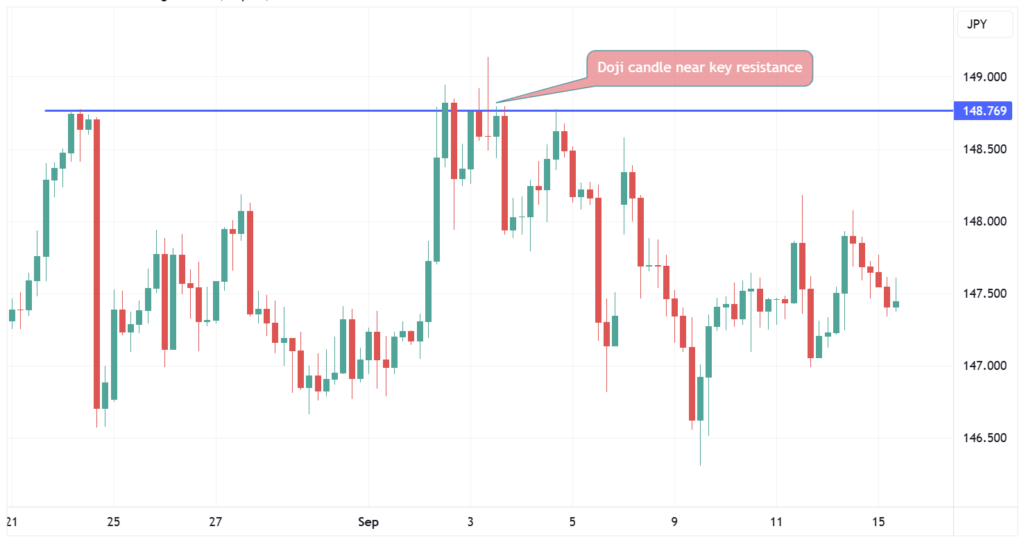
Example: Doji candle near key resistance level
Chart patterns
Common chart patterns include:
- Double top/double bottom. Tests a level twice without breaking it, then reverses after neckline confirmation.
- Head and shoulders/inverse head and shoulders. A three-peak structure signaling bearish (classic) or bullish (inverse) reversals.
- Rounding tops and bottoms. Indicate gradual momentum loss before trend reversal.
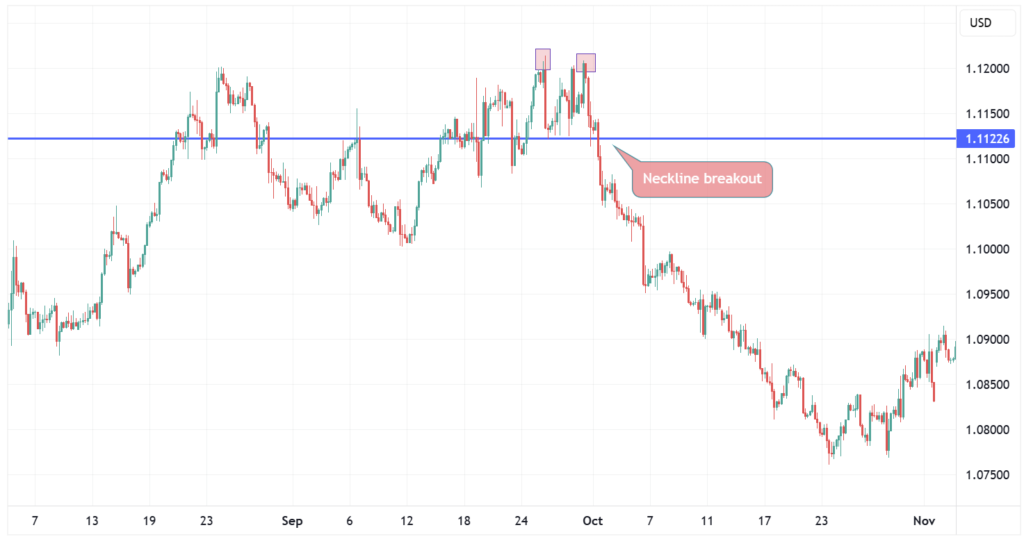
Example: Double top pattern
Indicator-based signals
Indicators act as confirmation tools. Divergence between RSI or MACD and price often signals weakening momentum. Traders may also rely on overbought/oversold readings—for example, a bullish reversal setup with RSI below 30.
This combination of chart and indicator analysis makes reversal trading a flexible trading strategy for both forex prop trading and other asset classes.
Risk management in a funded trading account
Spotting reversals is difficult in real time, and false signals are common. That’s why risk management is essential, especially for traders working with a funded trading account where strict rules apply.
- Aggressive entry. Jumping in at the first sign of a reversal, with tighter stop-losses but higher false signal risk.
- Conservative entry. Waiting for confirmation or a retest, which improves reliability but requires wider stops.
Stop-loss orders are typically placed just beyond the reversal point, while exits target the next significant support or resistance. Tools such as trailing stops or trendlines may also be used.
These practices are equally applicable in stock prop trading, where controlled risk is the foundation of long-term success.
Why reversal trading is a reliable prop trading strategy
Reversal setups provide strong advantages for prop traders:
- They support consistency in trading by generating frequent signals across multiple markets.
- Compared to a trend trading strategy, reversals often offer superior reward-to-risk ratios.
- They enhance a trader’s adaptability and improve trading psychology, encouraging discipline and patience.
For many traders, reversal setups become a cornerstone of their prop trading strategy, allowing them to grow within firm challenges while minimizing drawdowns.
Example of a reversal trade
Consider a trader using reversal setups on crude oil (USOIL). Price bounces off the $55.15 support level, suggesting a possible trend change. Instead of entering immediately, the trader waits for a retest. When the retest holds, they enter long, place a stop-loss below the support, and set take-profit near the $65 resistance level.
This conservative approach highlights how combining patience with proper risk management can make reversal trades highly effective.
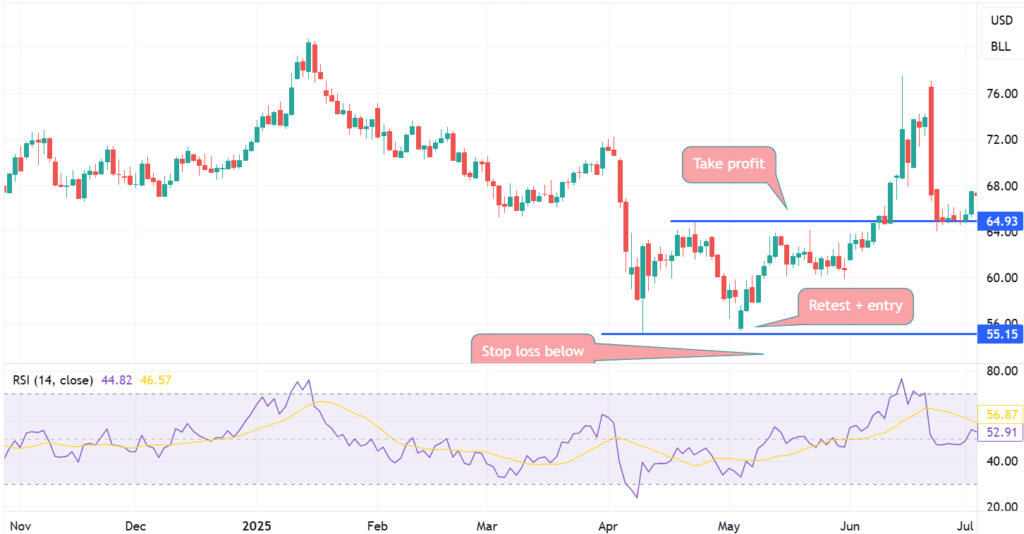
Trade example
Ready to test this strategy?
Reversal trading is a flexible and profitable prop trading strategy designed to capture trend changes across asset classes and timeframes. By combining chart patterns, price action, and technical indicators, traders can improve accuracy and manage risk effectively.
For those working with a funded trading account, reversal trading offers frequent opportunities, attractive risk-to-reward ratios, and the chance to strengthen trading psychology and decision-making skills.
Whether applied to forex prop trading or stock prop trading, reversal trading provides a powerful alternative to the traditional trend trading strategy.
If you are a trader, chances are good you already heard the phrase “the trend is your friend.” Trend trading strategy is a popular prop trading strategy that aims to capture profits by following the prevailing market trend. For prop traders, it does not matter whether prices are going up or down. What matters is that there is a trend they can capitalize on with their funded trading account.Trend trading strategy explained
Before diving deeper, it is crucial to understand what a trend is. On a chart, this appears as higher highs and higher lows for an uptrend, or lower highs and lower lows for a downtrend.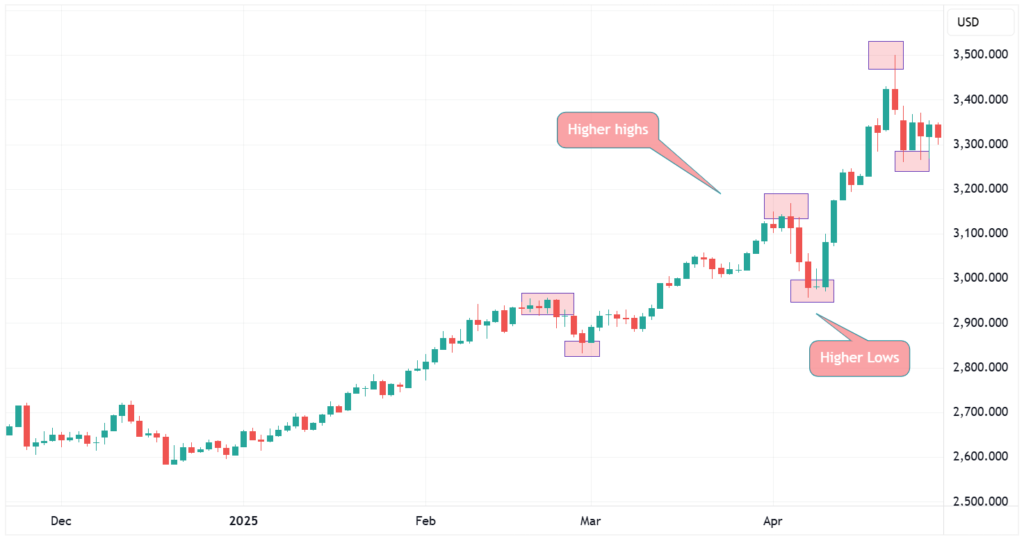
How trend trading works in prop trading
When trying to pass a prop trading challenge, there are strict rules about drawdown and profit targets. A trend trading strategy often produces a favorable risk-to-reward ratio, which makes sustainability easier. Because trend setups typically require fewer trades, the risk of making repeated mistakes is reduced. Even if the win rate is modest, the potential size of winners often outweighs small losses. For any prop trading strategy, consistency and discipline are key. Clear rules, from entry to management and exit, make trend trading attractive. It also fits well with forex prop trading and stock prop trading, as both asset classes generate strong trends during news events and market cycles.How to identify a trend
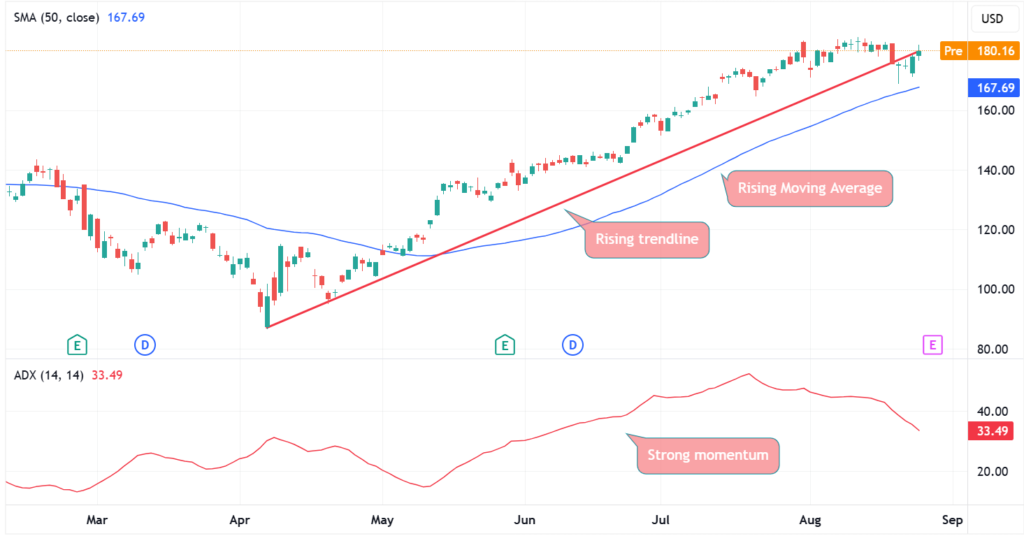
Most traders use candlestick charts, checking whether markets show higher highs and lows (uptrend) or lower highs and lows (downtrend). Trendlines are another tool, though drawing them can be subjective. Indicators such as moving averages or the ADX (average directional index) provide additional confirmation of the trend’s strength.-
- Moving averages: shorter MAs (21 EMA) react quickly but give more false signals; longer MAs (200 EMA) are slower but more reliable.
-
- ADX: shows both the strength and direction of a trend.
Entry and exit methods
Trend traders want to capture as much of a move as possible. Popular approaches include breakout trading and pullback trading.Breakout trading
When the market consolidates, traders watch for price to break out in the direction of the trend.-
- Buy signals appear when an uptrend breaks above resistance.
-
- Sell signals appear when a downtrend breaks below support. Stops are placed just beyond broken levels, with take profits set at the next major zone, ensuring at least a 1:2 risk-to-reward ratio.
Pullback trading
Instead of waiting for consolidation to end, pullback traders enter when price temporarily moves against the trend. Entry can be at classic support and resistance levels, Fibonacci retracements, pivot points, or moving averages.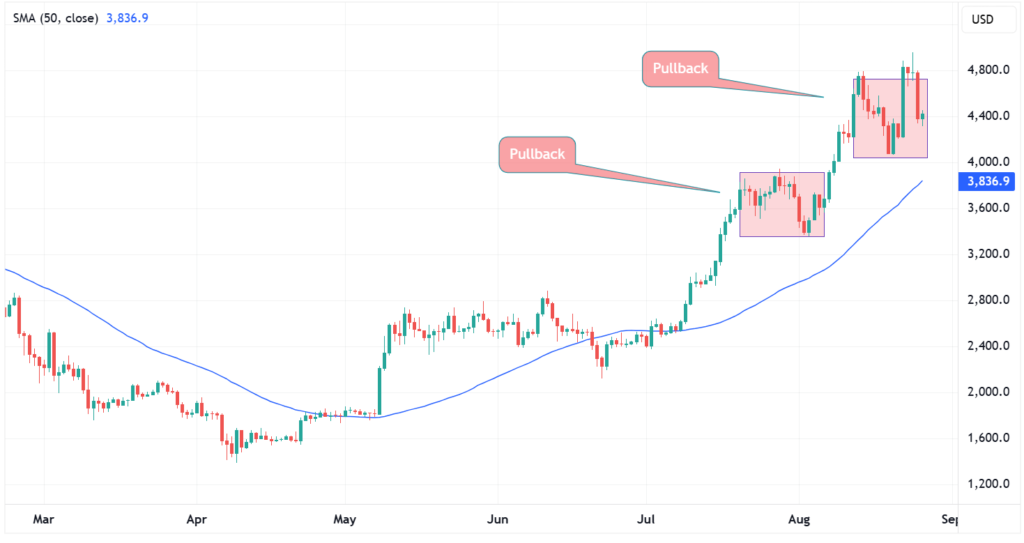
Risk management in a funded trading account
Risk management is crucial for anyone trading with a funded trading account. Prop firms set rules for maximum daily loss and overall drawdown, but traders should also apply their own limits.-
- Risk per trade: keep it below 1% of account balance to preserve longevity.
-
- Personal drawdown limit: if losses exceed 5%, pause trading and reassess.
-
- Consistency in trading: using the same position sizing rules avoids reckless decisions.
Example of a trend trade
Consider EUR/USD in an uptrend, confirmed by higher highs, higher lows, and a rising 50 EMA. After testing strong resistance at 1.1577, price consolidates, then breaks out decisively. This breakout provides a long entry, with a stop just below 1.1577 and a profit target at the next resistance. This setup demonstrates how trend trading strategies can be applied in forex prop trading, combining technical analysis with structured risk management.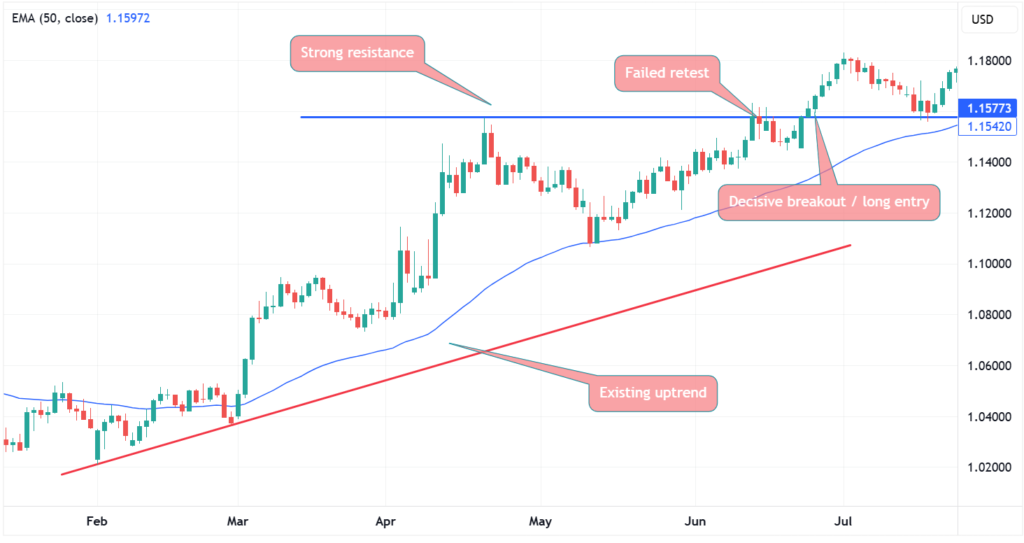
Why trend trading is a reliable prop trading strategy
Trend trading strategy is popular because it works across timeframes and markets. Whether trading currencies, equities, or crypto, strong trends appear regularly. For traders using a funded trading account, trend trading offers:-
- Clear setups that reduce emotional decision-making
-
- A sustainable risk-to-reward profile
-
- Compatibility with prop firm rules on drawdown and profit targets